Matt Simone · Founder, Webbed Apparel · Kingston, Ontario
Why Your Arms Go Over Your Head While You Sleep
You didn’t choose that position. That’s exactly the problem.

Somewhere around two in the morning, one of them travels.
You go to bed with your arms down.
Up past your shoulder, over your head, under the pillow. You have no idea it happened. You find out when the alarm goes off and your shoulder is stiff, or your arm has gone numb, or your hand is buzzing with pins and needles, or you just feel like you slept badly and can’t say why.
If you’ve never done this, this article isn’t for you.
If you have, you already know the strange part: you can’t decide not to. You’ve probably tried.
You’re not imagining it. But it’s probably not what you think.
Here’s what I can say honestly, and what I can’t.
There’s a narrow passage between your collarbone, your first rib and your shoulder blade. Nerves and blood vessels headed for your arm and hand run through it. The American Academy of Orthopaedic Surgeons describes overhead activity as compressing that space. Cleveland Clinic notes that pain from that compression usually gets worse when you raise the affected arm. That’s the passage your arm’s nerves and blood vessels run through — which is why an arm held up there for hours can wake up numb, tingling, or slow to move. That is anatomy. It’s true whether you’re awake or asleep.
What I’m not going to tell you is that sleeping with your arms up caused your shoulder problem. I went looking for the evidence. It isn’t there. A 2018 study of 761 workers found no link between overhead sleep positions and shoulder pain at all.* That study has a catch its own authors point out: people whose shoulders hurt may have already quit sleeping with their arms up. If you’re reading this, you haven’t been able to.
So here’s the thing I can actually stand behind, and it’s the only thing that matters: you already know the position bothers you. You wake up stiff, or buzzing, or just wrong, and you’ve noticed it happens on the nights your arm goes up.
I’m not here to diagnose that. I’m here to give you a way to stop doing it.
* Holdaway, Hegmann, Thiese & Kapellusch. BMC Musculoskeletal Disorders, 2018; 19:408.

Six hours is not six seconds.
Put your arm over your head right now. Hold it. Nothing happens — you’re fine.
That’s because you’re awake. After twenty or thirty seconds you’d put it down without thinking about it. Your body is very good at not staying in positions it doesn’t like.
Asleep, that system is off. You get into the position and you stay there. Not for thirty seconds — for half an hour. An hour. Night after night, for years.
There’s one place where experts control an unconscious person’s arm for hours: the operating table. The American Society of Anesthesiologists’ advice is to keep a patient’s arm below 90 degrees — not because the position is dangerous for a minute, but because the patient can’t move it.
That’s the whole difference. It isn’t that the position is dangerous. It’s that you’re holding it far longer than you would ever hold it on purpose.
Everything on the list needs you awake.
Pillows under the arm. Pillows on the chest. Sleeping propped up in a recliner. Taping. Wedging yourself against a wall. Deciding, firmly, before bed, that tonight you won’t do it.
They share one flaw: they all require your cooperation, and you’re unconscious. The pillow ends up on the floor. You roll off the wedge. The decision lasts until you fall asleep.
Some people end up in a sling. If a surgeon gave you one, wear it — it’s doing a specific job for a specific recovery. But a sling is not a comfortable way to sleep for months, and most people looking for an answer here aren’t post-op.
One customer told me she’d been scouring eBay looking for something that would work. She hadn’t found anything.
I looked too. Everything I found was clinical — braces, posture shirts, one at $189 with a surgeon’s name on it. All built for daytime. Nothing for the six hours that actually mattered.

So I put a zipper down each side of a shirt.
I have very flexible shoulders. I’d put my arms up in my sleep and wake up hurting. After enough mornings like that, I made myself a shirt.
It’s a long-sleeve cotton tee with a separating zipper set into each side, running from the armpit outward along the underside of the sleeve. About fourteen inches.
Zipped, the sleeve is joined to the body of the shirt. You can still roll over, shift, put your arm across your chest, get comfortable. Your arm just can’t travel up above your shoulder. Unzipped, the sleeve is free and it’s an ordinary long-sleeve shirt.
The slider locks wherever you set it, so you choose how much. All the way open is no hold at all. Down to the elbow is a little. All the way down is the most. One arm or both. Most people land at the elbow and stay there.
No straps. No brace. No pillow to lose. Nothing to remember at 3am.
“They do take some getting used to but I am persisting for the greater good.” — Christian
Thirty nights. If it isn’t for you, email me and I send a label.
Patent pending.
Bed only. Unzip before you get up — every time.
Zipped, your arm can’t go above your shoulder. That also means it can’t catch you if you trip. Unzip both sleeves before you stand, and don’t wear it zipped while walking, on stairs, or anywhere you could fall.
If you get up in the night, unzip first — it takes two seconds. It’s a sleep shirt. Treat it like one.

We’re not a medical device, and I’m fine with that.
No FDA registration. No clinic behind us. No surgeon’s name on the label.
It’s a shirt with a zipper down each side. That’s the entire idea — and it’s exactly why it works on someone who’s asleep and not paying attention. Nothing to remember, nothing to strap on, nothing that ends up on the floor by 3am.
I’m not going to tell you it treats anything.
Who shouldn’t use it
If you’re recovering from a stroke or a spinal cord injury, or you can’t easily move your own arm, please don’t — talk to your physiotherapist.
If you’re post-surgery and your surgeon has you in a sling, that sling is doing a job this shirt isn’t designed for. Ask them first.
Same if you have a pacemaker or another implant and you’ve been given movement restrictions — ask your cardiologist before you add anything at night.
The first few nights, you’ll notice it.
You’ll reach up out of habit and feel the shirt stop you. That’s not a defect, that’s the thing working.
“It is going to require some training on his body’s part to stop sleeping that way.” — Charlotte, buying for her husband
After the first week most people stop noticing it, which is the point.
Version 2 is out now.
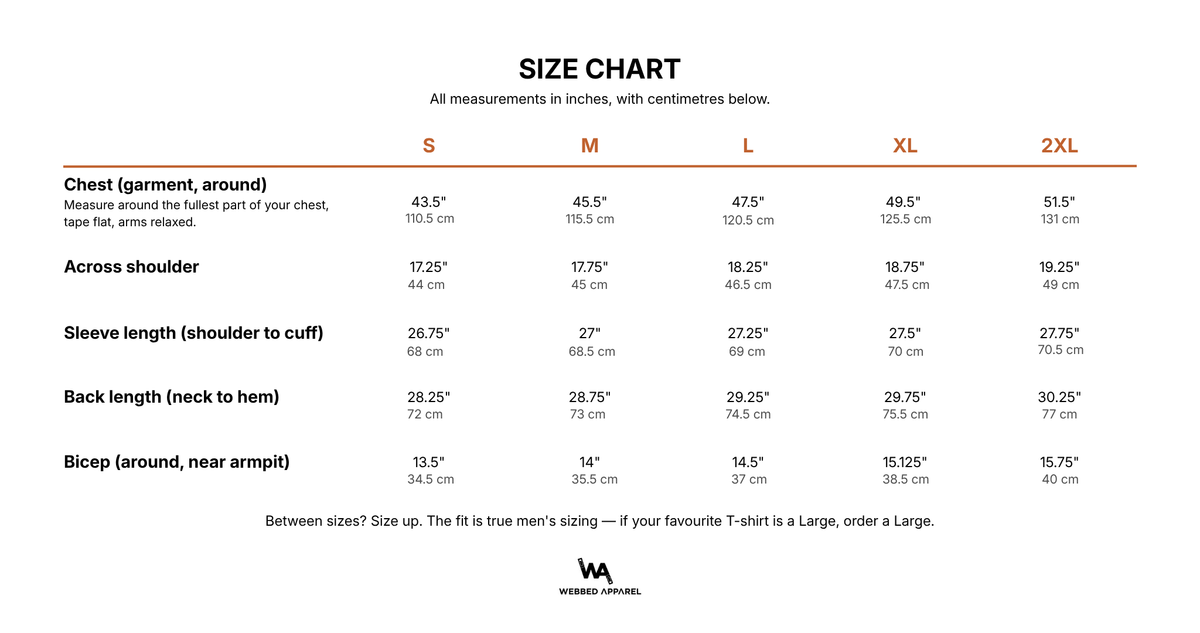
True men’s sizing from Small to 2XL, longer sleeves with thumbholes so they stay put, lighter fabric, and a stronger, smoother zipper. 95% cotton, 5% spandex. Machine wash — zip it closed first.
$88 USD, shipping included, anywhere in the US or Canada. Nothing added at checkout.
Thirty nights. If your shoulder doesn’t care, email me, I send a label, you get refunded. No form, no questions.


Sleep Shirt with Arm Control
Sleep Shirt with Arm Control
Shipping included, US and Canada. Nothing added at checkout.
Bed only. Unzip both sleeves before you get out of bed — every time.
Thirty nights. If your shoulder doesn’t care, email contact@webbedapparel.com — we send a label, you get refunded.